The 2014 thriller, The Babadook, shows the tribulations of widowed motherhood and the deep repressions that are often attached to the household. Before looking fully into the film, it is important to analyze David Skal’s writings in, ‘It’s Alive, I’m Afraid.’
The chapter ‘It’s Alive, I’m Afraid’ deals largely with the growing popularity of shocking imagery and monsters in mid-century film. Skal uses films as an example of this phenomenon including, Rosemary’s Baby, The Exorcist, and Eraserhead, which all gained popular followings and boosted the horror genre through grotesque imagery and the terrible effects of child-birth.
The recurring theme in Skal’s writings is his thoughts on contraception’s and birth control pills. With the introduction of the Pill, an era of sexual freedom was ushered in. With this, came horror movies that included shocking stories about reproduction and sex. This echoes the times as the ideology around reproduction was changing and seen as less of a beautiful occurrence.
Skal also speaks about the repression that mother’s would accumulate, often attached to the fear of parenthood and the resentment of children. Skal references a few extreme views on children that say they are the a penalty for sex and drag the parents down. These examples will be key in the analysis of the Babadook.
The Babadook is a film about the relationship between a mother and a child, and how it can lead to loads of repressed anger and hatred especially for mother on her child. Amelia is a widow that lost her husband in a car accident as she was being driven to the hospital to have her only child, Samuel. Not only is Amelia penalized with this for having her child, but also with the fact that Samuel is troubled and an annoying nuisance to everyone he comes in contact with.

Samuel is kicked out of school and must be looked over constantly by Amelia, which strongly diminishes her career, sex life, and overall mental health (shown above). This is echoed by Skal’s writings on in ‘It’s Alive, I’m Scared’ when he states, “Children are the penalty to be paid for having sex, a scourge not much different than the ‘punishment’ of aids. From a liberal perspective, children are socioeconomic baggage that can drag you down.” This is a strong theme in the Babadook because Samuel’s torment of Amelia completely drags her down.
The monster that enters the movie known as The Babadook can be interpreted as a shadow archetype created by Amelia to terrorize Samuel and let out her most deep seeded hatred of him. Supporting evidence shows that Amelia wrote children’s book, has a deteriorating mental state, and is shown numerous times with black ink all over her hands, much like that used in the book she reads to Samuel that soon haunts them. The idea is that the Babadook is the terror she feels on the inside. Amelia’s repressed feelings are supported by Skal’s writings on taboo subjects and ideas saying, “The taboo subjects include fear of parenthood, guilt over abortion, and resentment of children coupled with the desire to remain a child one-self.”
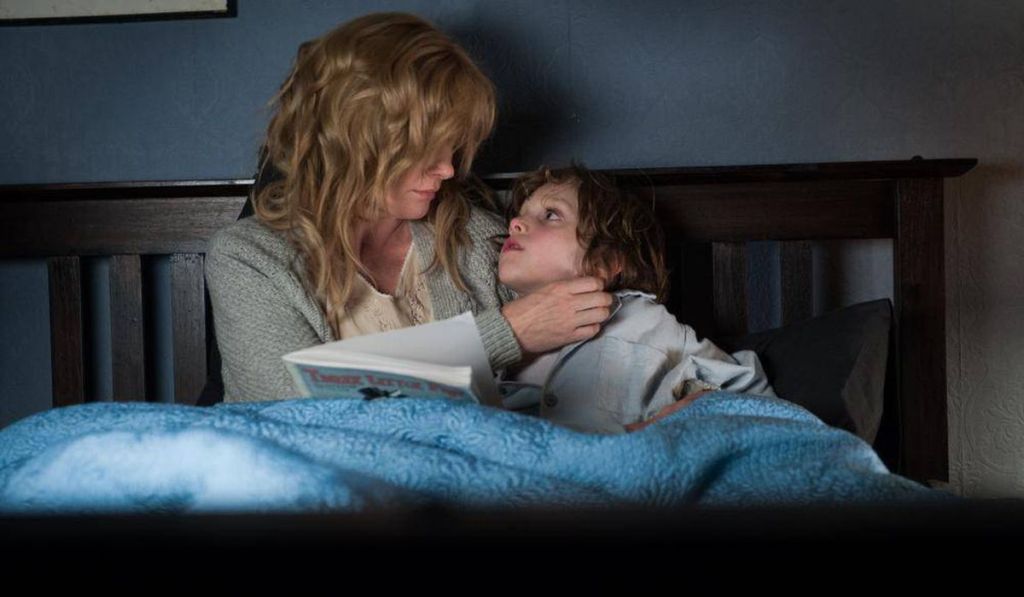
Another interesting aspect of the Babadook is the Oedipus complex in its reference to Samuel and his deep feelings towards his mother. Samuel being the only other person in the house has created an idea that he must protect his mother as long as she protects him. The young child adopts many of the roles that a father would have, such as sleeping in the bed with his mother (shown above) and staying up late watching TV with her. This is supported by Chris Dumas’ ‘Horror and Psychoanalysis’ when he writes, “Your parents are objects of fear and love, of hatred and desire- of all emotions, of all effects.” It is apparent that Samuel loves his mother deeply despite all the hell he brings to her through a slew of chaotic actions.
The Babadook is all about mother and child, with the torturous effects that the relationship can have on both parties. The themes of repression and angst towards toward one another can lead to extreme thoughts of violence and murder. The result is a shocking display of horror and a deterioration of mental health.
 Derek Stoberl CMS 353