The 1987 horror film, The Stepfather is a film that brought a refreshing concept of family chaos to the genre at the time. Before analyzing the film it is important to summarize and review Tony Williams writings in “Trying to Survive on the Darker Side”.
In Williams writings he begins by looking at the step back in overall film quality that the horror movies of the 80’s showed in comparison to the prior decade. In the 70’s, films such as The Exorcist, The Texas Chainsaw Massacre, and many others had a postmodern approach that often ostracized average American life through a theme of opposition. In the 80’s, gore spectacles and repetitive teen slaughter was present in most of the box office sensations such as Friday the 13th and Nightmare on Elm Street franchises, showing more of a hesitancy to the American life.
At the route of these movies is the constant theme of the patriarchal families and the trauma they have on each other to create horror movie moments. Williams argues that the villains of slasher films often represent the sadist and masochistic intents of the male subconscious. In doing this, they produce generations of victims that are ever effected by this cause.
In addition to the patriarchal themes, the role of the final girl also takes a more progressive and masculine approach in 80’s horror movies according to Carol Clover. Williams generally supports this claim, bringing to attention that the final girl plays less of submissive role and more of a castrating phallic wielding role. At the end of the film, the final girl is portrayed as a heroine instead of a survivor.
Looking at The Stepfather, the patriarchal sadism of 80’s horror is in full display. This especially comes to light with the authority that father figures exhibit on their wives and children. Jerry Blake, a serial family murderer, courts a widow Susan and looks to achieve a perfect American life with his new found family. However, the rebellious daughter Stephanie has the instincts to look into her new stepfather.
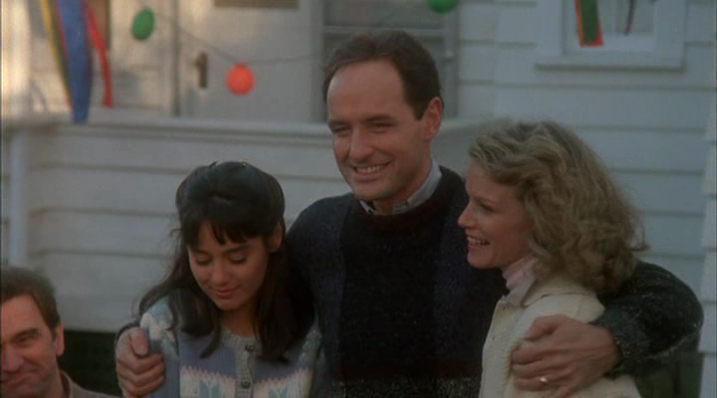
The constant relationship of Jerry and Stephanie is representative of the average household. When Stephanie is caught kissing a boy, Jerry takes action and drives the boy away from Stephanie. In addition, Jerry looks to control and force Stephanie into an ideological relationship, when his underlying intentions are that of sadism, shown above. This theme is supported by Tony Williams when he writes, “an act of patriarchal physical violence is being perpetuated. Whether actual or fantastic, it still involves a master-slave power relationship, one stemming from within the patriarchal family.” The overall theme of The Stepfather is precisely this, a controlling and insane father figure cloaking his horrors with American life. Jerry does not care about the way he bonds with Stephanie, but about how it looks from an outside perspective because his life is entirely built on an image.
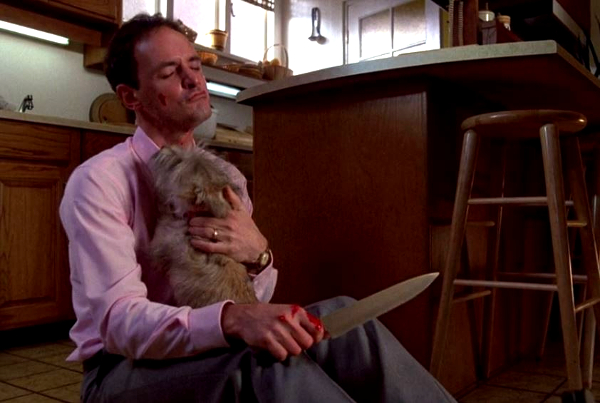
Stephanie is the an unique incarnation of the final girl, especially with regards to her age and behaviors. While she appears as an innocent young girl, Stephanie is a rebellious teen that is both cunning and mischievous. While the final girl is often a virgin, Stephanie is promiscuous to her crush and had numerous behavior incidents at school leading to her being expelled. This is in line with Williams writings on progressive final girls saying, “Freedom from ‘family values’ is a fundamental axiom for progressive moments within horror films.” Stephanie’s role in The Stepfather is to free her and her mother from the patriarchal family values. This is achieved when Stephanie stabs Jerry to death with his own knife, or phallic object(shown above), achieving full castration.
The overarching presence in The Stepfather, is Jerry’s male gaze over the women in his life. While he is perhaps not as overtly sexual as other patriarchal characters, it is the basis for his actions. This is once again displayed by his determination to force Stephanie into loving him. Williams writes, “As Tania Modleski remarks, the Oedipal father may still lurk withing the text (and the Final Girl) is a hidden point of reference in any mainstream narrative. It is a case of molding one into a gender position and child abuse towards Stephanie in the film.
Overall, The Stepfather builds on the rebellion against the classic American value system by overtly destroying it after portrayal in the most sadistic sense. This film shows that the castration of the nuisance that is the patriarch frees the victims from its horrors and that the masochistic intentions of the patriarch can be extinguished.
 Derek Stoberl CMS 353