Alfred Hitchcock’s 1960 horror classic, Psycho, is much more than a terrifying thriller, but a psychological masterclass on the male gaze and effects on a female protagonist. The main female, Marion Crane, is an interesting take on the typical women shown in horror films, because she is a single working women that is on the lamb after stealing a large sum of money from a powerful businessman. While Marion’s situation is unique, she is still used as an enabler for murderer Norman Bates and his character arc. This is first shown through Bate’s peephole at his motel, to which he watches Marion undress in private. This is a very early use of voyeurism, which not only caters to Bates, but the male audience watching the film. This interesting dynamic also employs scopophilia, which Hitchcock often employs, giving the audience the feel that they are seeing the woman alone undressing. This scene uses Marion as an object of pleasure for two separate viewpoints.
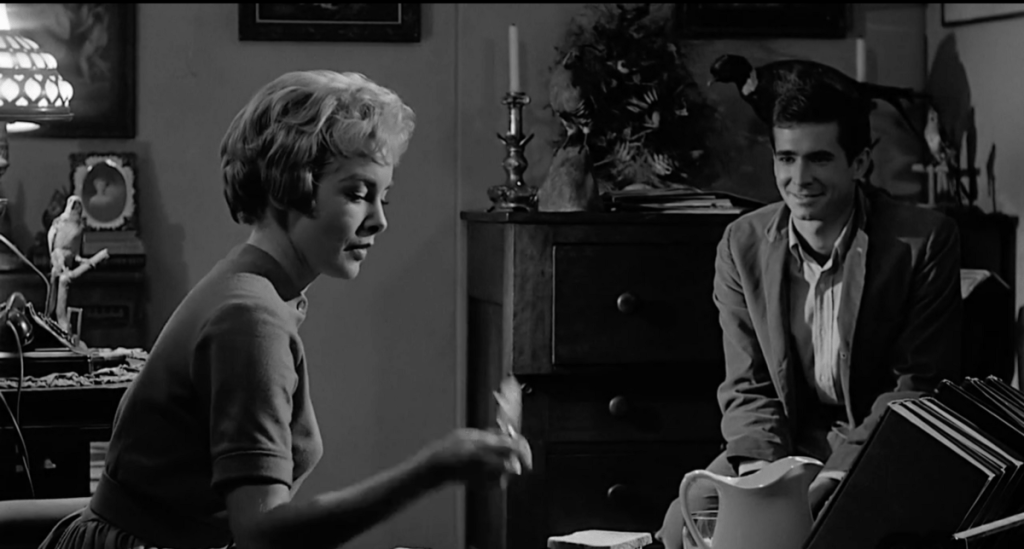
Upon Marion’s first visit to the Bates Motel, it is quite clear that Norman is infatuated with her, with Marion not feeling mutual. This is the presence of the male gaze in the film. Linda William’s in her writing “When the Woman Looks” writes, “Like the female spectator, the female protagonist often fails to look, to return the gaze of the male who desires her.” The image shown above ties in this quote with the situation in Psycho, because Norman takes in Marion by giving her shelter, food, and interest with a strong amount of desire for her, but Marion is blind to that and does not realize the intensity of the situation she is in.
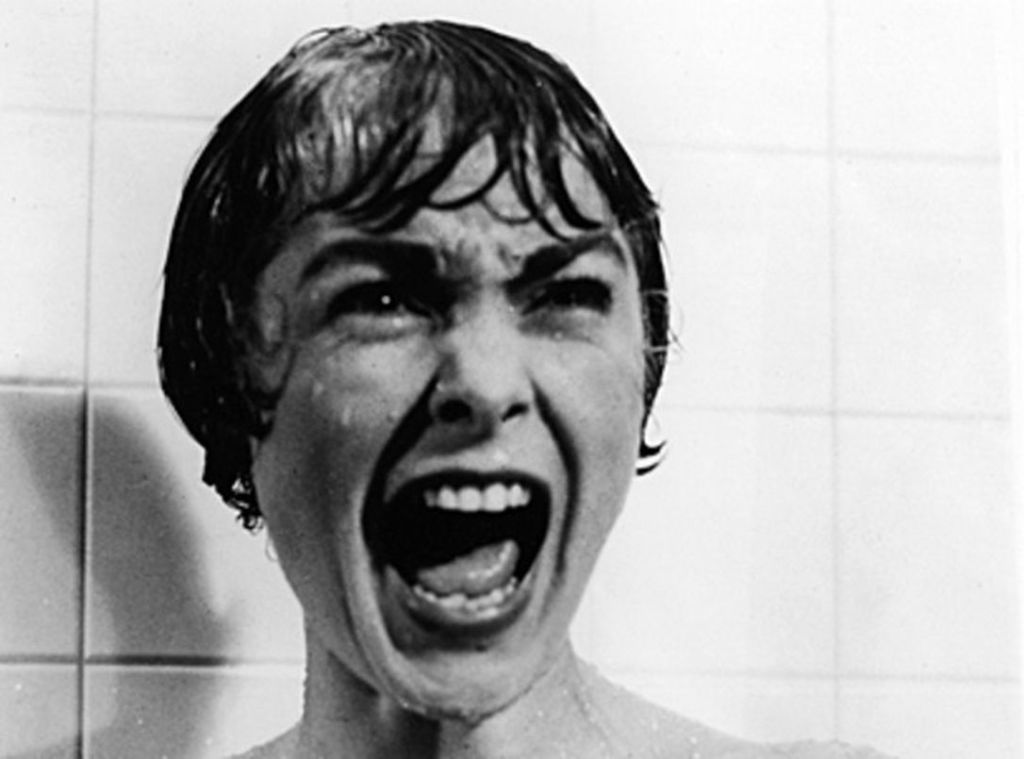
In the famous shower scene in Psycho, the view of Norman Bates is shown in addition to Marion’s view. This gives the audience the ability to adopt the viewpoint of a psychopathic murderer, in which there is more clarity into his killings. The image shown above is Norman’s view of Marion as he springs on her in the shower. As Marion looks at her killer, she is shown in a monstrous way. This is supported further in Linda Williams writing “When the Woman Looks” when she writes, ” this thus displaces, the female victim onto an audience that is now asked to view the body of the woman victim as the only visible monster in the film.” Marion is shown in this way to be recognized as a monster, much like Bates, because she is an equally damaged person.
Throughout Psycho, Norman Bates controls the fantasy for the audience to adopt. In Laura Mulvey’s ” Visual Pleasure and Narrative Cinema,” she writes “the man controls the film fantasy and also emerges as the representation of power.” Norman’s power and viewpoint is the driving force of the film, with Marion Crane serving as a passive woman, or exciting victim, along the course of the film.
Psycho serves as a film that utilizes women as fuel for the psychotic male antagonist. In this sense, the male gaze is used to give the audience a look at a seemingly helpless women-in-danger, all part of an exciting fantasy of a psychotic killer.
 Derek Stoberl CMS 353